Programming is the process of writing a program using a computer language. A
program is a set of instructions which a computer uses to do a specific task (e.g. a solution to a Math’s problem).
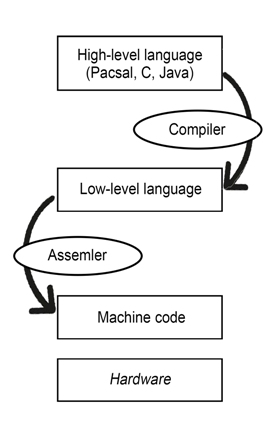
The only language a PC can directly execute is
machine code, which consists of 1s and 0s. This language is difficult to write, so we use symbolic languages that are easier to understand. For example,
assembly languages use abbreviations such as ADD, SUB, MPY to represent instructions. The program is then translated into machine code by software called an
assembler.
Machine code and assembly languages are called low-level languages because they are closer to the hardware.
High-level languages, however, are closer to human languages; they use forms resembling English, which makes programming easier. The program is translated into machine code by software called a
compiler. Some examples are:
• FORTRAN – used for scientific and mathematical applications
• COBOL – popular for business applications
• BASIC – used as a teaching language; Visual BASIC used to create Windows applications
• C – used to write system software, graphics and commercial programs
• Java – designed to run on the Web;
Java applets are small programs that run automatically on web pages and let you watch animated characters, and play music and games.
The languages used to create Web documents are called
markup languages; they use instructions (markups) to format and link text files. Example are:
• HTML – the code used to create Web pages
• VoiceXML – it makes Internet content accessible via
speech recognition and phone. Instead of using a web browser on a PC, you use a telephone to access voice-equipment websites. You just
dial the phone number of the website and then give spoken instructions, commands, and get the required information.