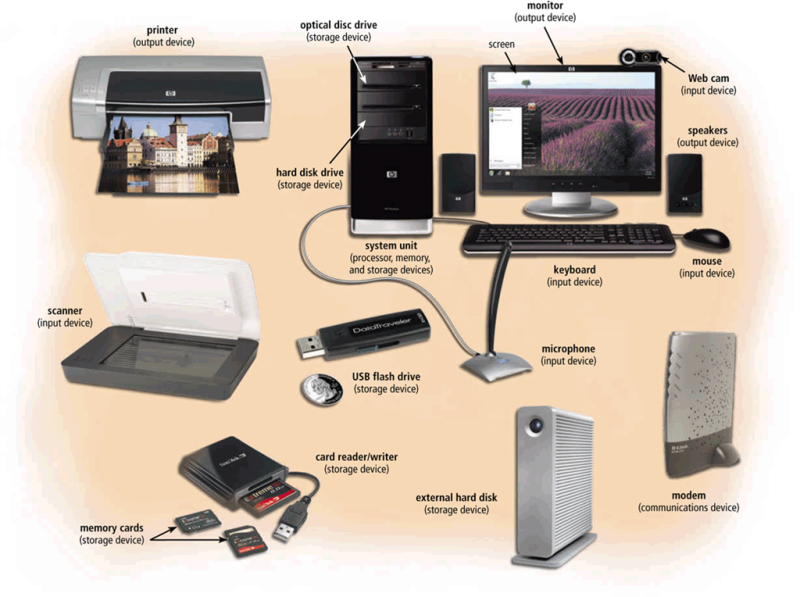
A computer is an electronic machine that accepts, processes, stores and outputs information. A typical computer consists of two parts: hardware and software. Hardware is any electronic or mechanical part of the computer system that you can see or touch. Software is a set of instructions, called a program, which tells a computer what to do. There are three basic hardware sections. 1. The CPU is the heart of the computer, a microprocessor chip which processes data and coordinates the activities of all the other units. 2. The main memory holds the instructions and data which are being processed by the CPU. It has two main sections: RAM (random access memory) and ROM (read only memory). 3. Peripherals are the physical units attached to the computer. They include: Input devices, which let us enter data and commands (e.g. the keyboard and the mouse). Output devices, which let us extract the results (e.g. the monitor and the printer). Storage devices, which are used to store information permanently (e.g. hard disks and DVD-RW drives). Disk drives are used to read and write data on disks. At the back of a computer there are ports into which we can plug external devices (e.g. a scanner, a modem, etc.). They allow communication between the computer and the devices.